Back in stock

Casse-tete
Composed in 1979 and edited on LP in 1984 by Amaryllis. Reissue on cd by Oral, 2008. Contrary to an electronic music delighting itself in soaring above reality in self abstraction, the concrete music of Bernard Bonnier has a down on earth hearing, and a dancing too, altough now and then out of beat. Bernard Bonnier has defined chameleon-music as: '...a mime* trying to beat its parth through the puzzle (casse-tête: literally 'head-breaker') of soliciting madness, sundowns, violence, science, love…
Pre-zoic cellways
Jaap Blonk: voice, powerbook, effects. Cor Fuhler: EMS synthi-AKS, turntable. Nice meeting in the electronic series of Kontrans.
String Quartets Vol 4
The most recent of his compositions which Rihm called “string quartets” date back a few years already, with a gap in the enumeration still waiting to be filled (the eleventh quartet is missing). Even a cursory comparison of the three works’ beginnings reveals Rihm’s “ability to find new and distinctly characteristic solutions for each piece, which, each in their own way, put a stamp on what is to follow.” (R. Frisius) The gentle pizzicati of Quartet No. 10 and the muted, shadowy chord of No. 12 …

Sinfonía n° 1 \'Canarias\' / Tocata vieja en tono nuevo / Los e
The Sinfonia n° 1 "Canarias" is dedicated to the composer's father, an old Canary Islander aged 94 at the time it was written. He was the reason why Cruz de Castro decided to focus the composition's middle movement wholly on the Canarian Folía. This special, important form of Canarian folk music appears both in its original form and in variations: "That's the way it should be: from the simple to the complex, from the melody line to the concentration: a harmonious whole." (Cruz de Castro) The Toc…

Lift
'It was on a night when sleep simply would not come, not matter how long I sprawled on the grass or how many pages of my book I leafed through. The black shaggy 'thing' expelled all the breath in its body. Phu phu phuu. And as it did so, something glowed softly at the crown of its head. Ahh, what a beautiful light! I should put a hat over it to stop it flying away. The black shaggy thing took his favourite hat, the one he had hung from a tree branch, and popped it onto his head. Perfect. Hirotom…
Hussein Mahmood Jeeb Tehar
Released just days after his death on January 14, 1999, this CD ranks as one of his best and most memorable, with groovy non-stop percussion sharing space with smooth backgrounds.
s/t
'Le Livre des Morts Ordinaires' (1987-90), 'Sur les chemins de Venise' (1983), 'Toccatanne N°3' (1975), 'Là où les roses sont froissées' (1971).
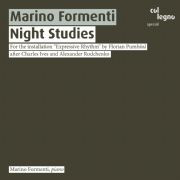
Night Studies
Somewhere between Alex- ander Rodchenko, Jackson Pollock and Charles Ives: Marino Formenti's piano studies based on an instal- lation by Florian Pumhösl as a listening experience! The brilliant Italian pianist has placed compositions by Charles Ives (»Thoreau« from the Concord Sonata, the song »Tom Sails Away«, and »Study 11«) under his magnifying glass and studied them, has taken them apart, searched them for resonances, assonances and silences, and confronted the results with Ives’ own methods…
Aerial # 3
This release is the third and last in the three-part Aerial series. Tod Dockstader is one of the all-time great figures in the world of musique concréte composition, with his "organized sound" works from the 1960s being amongst the most radical ever conceived -- in league with Schaeffer, Henry, Stockhausen, and Varese. Aerial is a rare new work in the realm of shortwave radio, from one of America's most experimental composers. Volume 1 was released in March 2005 inside a slipcase. Volume …
Live At Blå
First live document and fourth album overall from a band that mixes free jazz ecstasy with garage rock intensity. Even with no electricity, they make a hell of a noise and the album is an explosion of energy. Recorded at the Bla in Oslo.
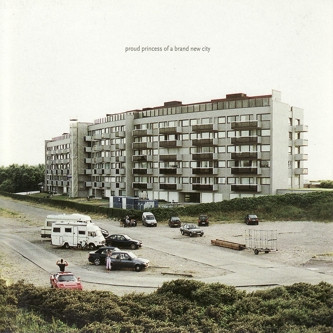
Proud Princess Of A Brand New City
After several hugely impressive concerts, where the visuals from Kurt D\\'Haeseleer are almost as important as the music, Guillaume Graux or Tuk comes up with a first cd. \\'Proud Princess of a Brand New City\\' contains mostly finished versions of the tracks he used the first three years at his live performances. The main sources on the cd are guitars, most of them so heavily treated that you barely hear it\\'s a guitar. Even if it\\'s only a beat, it might be guitar. You never know on this rec…

Sooner or later
Long out of print, now reissued in limited edition metal boxes by Bob himself,Sooner or Later is a powerful piece (for sampler) derived from the sounds of a Salvadorian boy burying his father: a shovel striking rock, a voice, a buzzing fly. Some guitar sounds by Fred Frith are added in part two. This tells only of the sources; what Bob does with them is compelling and hypnotic.categories CC, SAPT, EL, C

s/t
Françoise Barrière was born on june 12th, 1944. classical training: piano at the conservatoire de versailles; harmony and counterpoint at the conservatoire national supérieur de musique, paris. less classical training: service de la recherche, ortf; ethnomusicology at the ecole pratique de hautes etudes. in 1970, she founded in collaboration with christian clozier, the groupe de musique expérimentale de bourges (now called the international institute of electroacoustic music of bourges) that the…
Dawn
It was recorded at the legendary Total Music Meeting of Free Music Production in November 2000. Dawn is a composition played off the cuff of nearly 42 minutes. All the highs and lows of a longer composition are on this recording: searching and finding, restrained groping and violent erupting.... The decisive factor, however, is that this music is played by people who have nothing or very little to do with this attitude, by Gert-Jan Prins (see his solo record Prins Live, GROB210), by the saxophon…
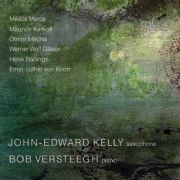
Saxophone & Piano 1
Maurice Karkoff (b. 1927) Sonatina fur Alt-Saxophon und Klavier (1985); Toccata -Varianter- Burla Henk Badings (1907-1987) La Malinconia (1949) Miklos Maros (b.1943) Undulations (1986); WernerWolf Glaser (b. 1910) Allegro, Cadenza e Adagio (1950) Otmar Macha (b.1922) Plac Saxofonu (1968) Ernst- tlothar von Knorr (1896-1973) Sonate fur Alt-Saxophon und Klavier (1932) Phantasie- Allegro Allegretto scherzando Signal. Works dedicated to the recording artists. JOHN-EDWARD KELLY, saxophone BOB VERSTEE…
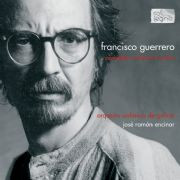
Complete Orchestral Works
Complicated, yet not complex: In order to create music as nature makes it, Guerrero employs fractal principles of composition.
Piano Music
Music as a message without words from far away – from our inner selves. Piano music as metaphor for the thrilling adventures of human existence.
Proximities
Finaly restocked: Line is proud to present Proximities the first solo recording by Steve Roden on the label since 2005′s critically acclaimed release, Airforms. "Proximities was recorded in 2010 during my time as the artist-in-residence at the Chinati Foundation in Marfa, Texas. I began by recording a performance of a series of tones played on an old battery powered Paia Oz, that were determined by the letters A-G as found in a text by minimalist sculptor Donald Judd. I recorded the tone seq…

Turning Dreams & Shifting Harbours
The Kidnapping Europe project was initialized by the artists Christina Clar (Paris, France) and Peter Jap Lim (Berlin, Germany) in 2001. Based on the "Europa Myth" (Zeus kidnapped the phoenician princess Europa and brought her to a continent which now has her name), the project aims to approach the topic of migration and the dreams, hopes and visions of migrants, in particular, from a contemporary perspective. In addition to their own work, which resulted in an installation that made its debut a…
For Bunita Marcus
For Bunita Marcus was written in 1985. "This work, which I have dedicated to Bunita Marcus, [...] deals with the death of my mother, and with the notion of a slow death. I simply didn't want the piece to die. So I used this unwillingness compositionally in order to keep the piece alive, like a patient suffering from an terminal disease, for as long as possible." (Feldman) It is not the loud raging, the last furious revolt of a dying human being that Feldman depicts here, but a slow nodding off a…